
awwwww. Imagine what the walls of his garden shed must look like.
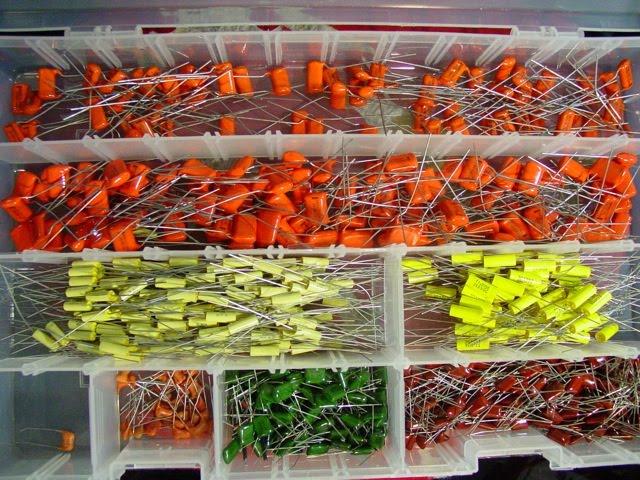 |
| "Orange Drop" capacitors & others |
 |
| New old stock "NOS" Black Cat capacitors. Note cool old box! |
 |
| NOS Black Cat capacitors, inside same box |
 |
| Very cool vintage Russian paper in oil (PIO), Teflon & other NOS capacitors |
 |
Many were made for Russian Military!! More paper in oil (PIO), Teflon & other NOS capacitors |


 |
| Glued carved and ready for laminate |
 |
| Tim doing some arm exercises. That's red hot in there. |
 |
| Prepped and ready to glue |
 |
| Many many clamps makes even pressure |
 |
| See alignment pin |
 |
| On! |
 Jim Campilongo (noted tele player and sideman for Norah Jones & Martha Wainwright) has been friends with Gary for decades. Here he's testing out a couple of prototype Teles (sent to him by Fender, matching Jim's original 1959 Tele - unique for, among other things, being the only year strings could be threaded through the back edge of the bridge as opposed to all the other years' Teles which thread strings through the body) as Gary removed the treble bleed capacitor and switches the tone control capacitor (Jim favors paper and foil .05). We also cut down the bridge height screws so they do not stick up above the saddle to keep from cutting your palm, and did some slight setup work. The twang is in the house!


Last month we performed some restoration work on a Gibson L-OO, a small body acoustic guitar from the 20’s-30’s, popular among blues and country artists. Its features include an Adirondack Spruce top, Mahogany back and sides, and Brazilian Rosewood fingerboard and bridge. The headstock has Gibson’s “stencil” logo which can help to date the guitar.
The first photo shows the condition of the bridge when the guitar was brought in to the shop. The back half of the bridge was cracked off straight across through the bridge pin holes and was almost completely un-glued from the top. We found a suitable piece of quarter sawn Madagascar Rosewood, which has similar characteristics to Brazilian, and set out to replicate the original bridge and fabricate a new bone saddle.
 There were several challenges in replicating this old bridge. First off, a third of the bridge was missing so the overall depth of the bridge had to be determined by looking at it’s footprint in the top of the guitar where it had been glued on previously. Secondly, the bridge pin spacing has to match up with the existing holes. We use dividers and calipers to determine these measurements and transfer them to the new bridge blank.
 Thirdly, the bridge base has to match the radius of the top of the guitar. The L-OO has a fairly pronounced radius of around 25 feet. If you place a straight edge on the top of the guitar and you will notice that the straight edge will rest on center and there will be space on either edge of the top. Many guitars have a slight radius built in to the top to help eliminate the bellying behind the bridge which can occur over time and is caused by string tension.
 Luckily this guitar still had great neck angle and the bridge could be made to almost exactly the same height as the original. After the shaping of the bridge was completed and the bridge pin holes drilled out, we made a clamping caul for the interior of the guitar which has the exact opposite or convex radius to the top. Temporary wood bridge pins help locate the bridge during glue-up and for layout purposes.
 Once the bridge is glued in place and we have determined the location for a properly intonated saddle, we use our saddle slotting jig to route for a new saddle. The bridge pin holes are reamed to fit the new pins, a new saddle is made, and the guitar is ready to be strung up. After some fine tuning with the set-up we were very pleased with the results and happy to hear this guitar for the first time. It has a wonderful midrange and a lot of volume.


